Berlin
You’ve landed, you’ve got the Brandenburg Gate photo on your phone, and now you’re standing at a ticket machine in a language you don’t speak while a man in plainclothes eyes your feet for an unvalidated ticket. This isn’t another “10 Best Currywurst in Berlin” list. It’s the operational survival guide — the stuff you actually Google after you arrive, the rules nobody tells you, the scams you’ll walk into by noon, and the real-money tricks that save you €40 a week on water and bottle deposits alone. Consider it your Berlin mental toolkit. If you’re stitching together a wider European trip, the same operational format covers Amsterdam, Prague, Budapest, and Lisbon — but Berlin has the strictest ticket-fine culture of the lot, so read this one twice.
What This Guide Covers (Seven Operational Clusters)
Every major on-the-ground headache falls into one of these seven clusters. Click into the deep dive for each:
- Scams — The petition grift at Brandenburger Tor to fake taxis at Hauptbahnhof, with exact street corners to avoid.
- Safe Neighborhoods — Per-district reality check: where you can walk at 3 AM and where to keep your phone in your front pocket.
- Night Transport — Last U-Bahn, weekend 24-hour trains, walking routes from clubs, and why the tram is your real BFF at 4 AM.
- Open 24/7 — Pharmacies that rotate, Spätis that never close, and the only supermarkets that work on Sunday.
- Money — Cash still king, hidden fees, tipping reality, Pfand deposit refunds, and the exact amount to pull out of the ATM.
- Arrival Setup — eSIMs that actually work, plug types, BVG tickets that cover everything, and what to do the instant you step off the plane.
- Insider Secrets — Berghain door non-sense, the real best döner, FKK lake etiquette, and why Mustafa’s is a lie.
What to Do the Instant You Land at BER
You clear customs at Berlin Brandenburg Airport (BER), Terminal 1, and your first three decisions determine how the next hour goes. Do not leave the arrivals hall without these three things:
1. Pull Cash at the Sparkasse ATM
Ignore the blue “Euro ATM” kiosks that charge €5.99 per withdrawal. Walk past the luggage belts toward the train station entrance — on your left is a Sparkasse ATM (fee-free for most European cards, ~€4 fee for non-EU but still cheaper than the kiosks). Take out €120 in mixed bills: two €50s, four €5s, and the rest in €10s and €20s. You need small notes because many Spätis and bakeries flatly refuse €50 notes for a €1.50 water. The same airport-ATM trap exists in Prague (Euronet kiosks, even worse fees) and Barcelona — Berlin is just where you’ll meet it first.
2. Buy Your BVG Ticket Before You Board
The BVG ticket machines are near the station entrance. They look intimidating — touchscreen, German first, but switch to English with the flag button at top right. If you are staying in Berlin for 48+ hours, buy a day ticket for AB zone (€9.90). If you only need to reach central Berlin once and will walk, you can buy a single AB ticket (€3.50) — but validate it. If you are heading to Potsdam proper, buy ABC (€11.40). For most tourists, AB covers everything: all S-Bahn, U-Bahn, tram, and bus within the city.
3. Get Online Instantly
BER has free Wi-Fi for 30 minutes, but it’s slow and drops after the session expires. Your best bet: buy a local eSIM before you land. If you didn’t, the Telekom shop at BER (level 2, near the train station entrance) sells prepaid SIMs — about €10 for 5 GB. For eSIMs, Airalo and Holafly work well on Telekom’s network. Avoid the vending machine SIMs sold near baggage claim; they have cryptic activation instructions in German. Plug advice: Germany uses Type F sockets (two round pins, same as most of continental Europe). If you’re coming from the UK (Type G) or US (Type A/B), bring an adapter — the airport electronics shop charges €12 for one you could get at home for €3.
The Späti Network – Berlin’s Real 24/7 Infrastructure
Spätis (Spätkauf, literally “late buy”) are the neighborhood corner stores that keep Berlin alive after midnight and on Sundays. Amsterdam has its night-shop equivalents (avondwinkels) and Lisbon has the mini-mercado, but neither network has the density or 24/7 reach of the Späti grid. There are roughly 1,500 across the city, concentrated in Kreuzberg, Neukölln, and Friedrichshain. They sell beer, wine, snacks, toiletries, phone chargers, cigarettes, and in some cases basic groceries (bread, milk, eggs, pasta). Most operate 10 AM – midnight, but a significant minority are open 24/7, especially along the U8 and U7 lines.
Späti Etiquette
- Bring cash. 80% of Spätis are cash-only. Some have an ATM inside with a €4.99 fee.
- Buy a beer — they expect one purchase, and you can drink it outside. That’s normal.
- Don’t try to use a card for a €1.50 purchase. You’ll be laughed out.
- If you need urgent cash, some Spätis offer “cashback” (Geld abheben) with a purchase — you buy a €0.80 water and they give you €50 from the register. Fee is usually €2–€5. It’s not a scam, it’s a service.
Sunday Survival: A Mini-Scenario
You land on Sunday at 11 PM. The REWE To Go at Hauptbahnhof closes at 10 PM. You are hungry and the hotel minibar costs €6 for a Coke. Walk to the nearest Späti — use Google Maps and search “Spätkauf” near your location. Most will be open until midnight, some 24 hours. Buy bread, cheese, a beer, and a bottle of tap-water refill. Total: ~€6. You survive. Do not order delivery at that hour unless you’re in Mitte or Friedrichshain; delivery apps (Lieferando) have long waits on Sunday night and many restaurants close Sunday evening.
The Pfand (Bottle Deposit) Reality – Free Money on the Street
That can you just chugged has value. Every plastic bottle with a Pfand logo is worth €0.25. Glass beer bottles (returnable) get you €0.08. Berlin is the only German city where middle-class retirees fish bottles out of trash bins as a side hustle — not because they’re destitute, because it’s legit free money. Amsterdam runs a similar statiegeld scheme (€0.25 per PET bottle since 2023), but Berlin’s is the only one where street-collecting is fully normalized.
| Container | Deposit | Where to return | Notes |
|---|---|---|---|
| Plastic bottle (PET, single-use) | €0.25 | Any supermarket Pfandauto | Most common — water, soda, energy drinks |
| Aluminum can | €0.25 | Any supermarket Pfandauto | Don’t crush — machine rejects |
| Reusable plastic bottle (Mehrweg) | €0.15 | Any supermarket Pfandauto | Thicker plastic, often beer brands |
| Glass beer bottle (returnable) | €0.08 | Supermarket or back to brewery | Look for “Mehrweg” symbol |
| Glass beer crate (case of 20) | €1.50–€3.10 | Same store you bought it | Keep the crate |
| Wine bottles | €0.00 | Glass recycling bin (color-sorted) | No deposit — green/brown/clear separated |
How to Collect
Look for the white-and-blue Pfand flasche symbol on plastic bottles. Don’t crush them — machines reject crushed bottles. Take them to any supermarket (Rewe, Edeka, Lidl, Aldi) and feed them into the deposit return machine (Pfandauto). You get a voucher to spend in-store or cash out at the register. Supermarkets are legally required to accept any bottle that they sell, even if you bought it elsewhere. Do not throw Pfand bottles in public bins — you’re throwing away 25 cents each. Give them to a homeless person collecting them, or collect them yourself and buy a coffee.
Pro tip: Check the shelf at the Späti — many sell Pfand bottles at a discount because they don’t run deposit machines. Buy a crate of water, drink it, return the bottles to a supermarket, pocket the difference.
Sunday Everything-Closed Rule (And the Exact Loopholes)
Sunday in Berlin is almost a religious holiday — same closing law applies across Germany, and you’ll meet a milder version in Prague (smaller shops shut) and Budapest (most groceries closed since 2015). Most grocery stores, bakeries (outside of bakeries in station), and all non-essential shops close by law. Tourists get caught starving at 2 PM with zero open supermarkets. Here’s your survival kit:
Loopholes That Actually Work
- REWE To Go / Edeka Express / your-fill stations inside major train stations: Hauptbahnhof, Friedrichstraße, Ostbahnhof, and Zoologischer Garten have small supermarkets open Sunday 8 AM – 10 PM. They’re expensive (€1.50 for a water bottle) but they’re there.
- Späti network: Hundreds of corner shops open 24/7 or late on Sundays. They sell beer, snacks, toiletries, and cigs. Limited fresh food, but enough to survive.
- Rotation Apotheken (pharmacies): On Sunday, every pharmacy closes except one per district on rotation. Look up Notdienst Apotheke Berlin or check the door of any closed pharmacy for a sign listing the nearest open one.
Critical rule: Buy your weekend groceries on Saturday. Berliners stock up on Saturday morning. You ignore this at your own risk. If you are staying near Boxhagener Platz or Maybachufer, note that the weekend Turkish market (Tuesday and Friday at Maybachufer) is your best source for produce — but it’s not open Sunday.
Jaywalking Fines – Yes, Cops Actually Ticket Tourists
In Germany, crossing against a red pedestrian light is illegal. The fine is €5 to €10. Berlin police will ticket tourists, especially if you’re near a school or a U-Bahn exit. Locals jaywalk all the time — but the split-second decision to cross on red while a cop is 30 meters away costs you €10. Just wait. The lights cycle fast.
Penalty also applies to crossing at a red light on bicycle. Riding a bike on the sidewalk (unless it’s marked as shared) is another €15-20 fine.
Outdoor Drinking – Legal, Except at Hauptbahnhof
Drinking alcohol in public is legal across Berlin — unlike Barcelona (€600 fines for street drinking) or London (Public Spaces Protection Orders in most boroughs). You can walk down the street with a beer, sit in a park with wine, party on the U-Bahn platform (though not on the train itself — technically forbidden). The one exception: the entire area of Hauptbahnhof (including the forecourt and the passage to Europaplatz) is an alcohol-free zone. A visible sign marks the boundary. Violation costs €40. Cops patrol it. Also: public urination anywhere in Berlin carries a fine of €35–€100, and police do enforce it in tourist-heavy zones near Mauerpark and the East Side Gallery on weekends.
FKK Nudity at Lakes – Normal, Don’t Stare
Berlin has designated nudist beach areas at lakes: Müggelsee (Strandbad Müggelsee has a FKK section), Schlachtensee, Krumme Lanke, and Wannsee (Strandbad Wannsee has both textile and FKK zones). This is not hidden, not sexual, and perfectly normal. You’ll see families with kids, grandmas sunbathing topless, and groups of friends playing volleyball entirely naked. Do not stare. Do not take photos. If you’re uncomfortable, stick to the textile zones. Nobody will harass you, but if you ogle, you’ll get called out.
FKK Lake Access – Practical Details
- Strandbad Wannsee: Take S1 to Nikolassee, then walk 15 minutes. Entry fee ~€6. The FKK section is to the left of the main entrance, clearly marked.
- Schlachtensee: Free access along the shore. No official zones, but locals will sit naked anywhere. Don’t be the only person in swim trunks if everyone around you is nude.
- Müggelsee: Reachable by tram 61 from Friedrichshagen station (S3). Strandbad Müggelsee is the largest lakeside beach in Berlin — huge FKK section.
- Bring a towel to sit on. Naked on sand is sandy in places you don’t want sand.
Tap Water – Excellent Quality, Save €40/Week
Berlin tap water is among the best in Europe — drinkable on par with London and Amsterdam, well above Barcelona (legal but heavy mineral taste) and Istanbul (locals buy bottled). It’s strictly controlled by Berliner Wasserbetriebe. You can fill your bottle at any tap without worry. A liter of tap water costs under €0.01. A plastic bottle from a kiosk costs €1.50–€2.00. If you drink 2 liters a day, that’s €3–€4 saved daily — €40 per week for a couple. Skip the single-use plastic.
One caveat: older buildings may have lead pipes in extremely rare cases. If you’re in a pre-1990 building and the water sits in pipes overnight, let it run for 10 seconds before drinking. Otherwise, it’s safe.
Emergency Numbers You Need in Your Phone
- 112 — Fire and ambulance. English operators available.
- 110 — Police. English operators available.
- 116 117 — Non-emergency medical on-call service. English spoken.
- 030 31 00 31 24 — 24-hour on-call doctor service (Ärztlicher Bereitschaftsdienst).
- 0800 00 22 833 — BVG (public transport) Lost & Found. Hours vary, but file a report online.
Cash Still King – The Real Payment Reality
Despite Germany being the EU’s economic engine, card acceptance in Berlin is not universal. It’s the most cash-heavy major capital in Europe — London is nearly cashless, Amsterdam is contactless-default, but Berlin still asks “Bar oder Karte?” with a slight tilt toward the first. Many bakeries, Spätis, kebab shops, taxis, and small bars only accept cash. You’ll see the sign „Bargeld nur” or „Nur Barzahlung” — cash only. Even some larger restaurants will refuse card for under €10.
Cash-only zones
- Spätis (80%)
- Most bakeries
- Kebab/döner stands
- Small bars & dive pubs
- Many taxis (or “terminal broken”)
- Flea markets & street food
- Many clubs at the door
Card-friendly
- Supermarkets (Rewe, Lidl, Edeka, Aldi)
- BVG ticket machines (mostly)
- Mid/high-end restaurants
- Museums, attractions, hotels
- Chain coffee shops
- Drogerie chains (dm, Rossmann)
- Online delivery (Lieferando, Uber)
Pull at least €100 from an ATM at the airport. Use bank ATMs (Sparkasse, Deutsche Bank, Commerzbank) — avoid independent Euro ATM kiosks with high fees. If a shop says „Karte nicht möglich”, don’t argue. Walk to the nearest Späti that has an ATM (often with fee ~€5), take out cash, and come back.
Carry a mix: €50 in small bills (€5, €10, €20) plus €50 in backup. Many places won’t accept €50 notes for small purchases. Real scenario: you order a döner at Rüyam (€6.50) and hand over a €50 note. The cashier gives you a look, checks the register, and reluctantly makes change. It’s legal tender, but you’re annoying everyone behind you in line.
When You Need Cards (and Which Cards Work)
- Supermarkets (Rewe, Lidl, Aldi, Edeka): They take Visa, Mastercard, Maestro, and EC cards. Almost never Amex.
- BVG ticket machines: Accept cash, EC, Visa, Mastercard. But some older machines are cash-only — always have coins ready.
- Taxis: About 60% take card, but the driver may claim the terminal is “broken”. Ask before you get in.
- Museums and major attractions: Most take card. But booking online in advance saves you the hassle.
- Amex: Largely useless in Berlin. Don’t rely on it.
Petition Scam at Brandenburger Tor, Fake Taxis at Hauptbahnhof
Two most common scams you will encounter (the petition variant also runs in Prague’s Old Town Square and Barcelona’s Las Ramblas — same script, different language):
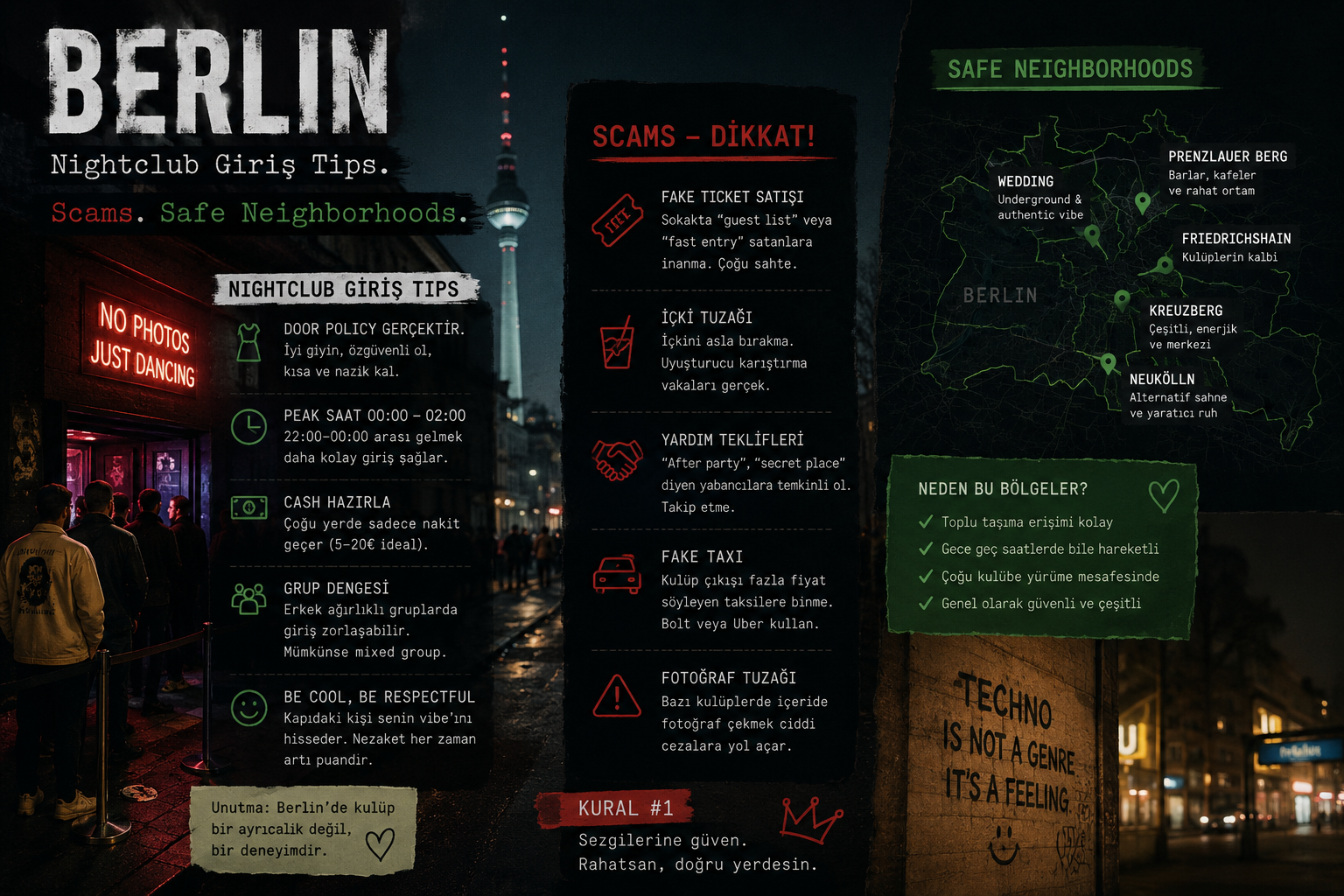
- Petition Scam — Near the Brandenburg Gate (especially at Pariser Platz and along Unter den Linden), a person with a clipboard asks you to sign a petition for “deaf children” or similar cause. They pressure you, then demand a donation of €5-€20. Sign nothing, say „Kein Interesse”, and walk away. They work in pairs: one distracts, the other tries to pick your pocket. Real scenario: A woman with a laminated ID approaches you at 11 AM by the Brandenburg Gate. She smiles, thrusts a clipboard. You sign. She points to a “suggested donation” line — €10. She will follow you for 50 meters. Just keep walking.
- Fake Taxi at Hauptbahnhof — Non-licensed drivers park near the station exit and offer rides. Real Berlin taxis are cream-colored with a “Taxi” sign on the roof and a meter inside. Always use the official taxi rank at the station. If you call a ride, use Uber or Free Now (the local equivalent). Avoid anyone who approaches you inside the station hall. Another variation: at the Hauptbahnhof taxi rank, a driver offers “flat rate” of €30 to Mitte — the meter would show €12. Tell them to use the meter or you’ll take the next cab.
Pickpocket Hotspots: U8, Kottbusser Tor, Alexanderplatz
U8 line is notorious — the Berlin equivalent of Barcelona’s L3 (Las Ramblas stretch) or London’s Central Line at Oxford Circus. Entire length, but especially stations Kottbusser Tor, Hermannplatz, and Alexanderplatz. Also: Brandenburg Gate crowd zones, the tram line M10 to Hackescher Markt, and the S-Bahn between Friedrichstraße and Zoologischer Garten during rush hour.
Keep phones and wallets in front pockets or cross-body bags. Backpack zippers get opened in 2 seconds on the U8. Specific tip: On the U8, stand with your back to the wall of the train car, not in the middle near the doors. If you’re in the middle, you’re target practice.
BVG Ticket Types – Real Talk
| Ticket | Price (2026) | Covers | Best for |
|---|---|---|---|
| Single AB (Einzelfahrschein) | €3.50 | One trip, 2h max, no return | One-off rides only |
| Short Trip (Kurzstrecke) | €2.40 | 3 U/S stops or 6 bus/tram stops | Tiny hop near hotel |
| Day Ticket AB | €9.90 | All Berlin until 3 AM next day | Most tourists, most days |
| Day Ticket ABC | €11.40 | Adds BER airport zone & Potsdam | Airport days, Potsdam trips |
| 7-Day AB | €44.00 | Week of unlimited AB | 5+ day stays |
| Group Day Ticket (5p AB) | €31.00 | Up to 5 adults, one day | Family or friends squad |
| Welcome Card 48h AB | €26.00 | Transit + ~200 discounts | Museum-heavy itinerary |
- AB zone covers everything a tourist needs: all of Berlin city limits, including Schönefeld Airport (BER) and Potsdam if you take the S7 or RE (verify — Potsdam is C zone for some trains).
- ABC zone needed for BER airport if you take the RE/RB from outside the city or for day trips to Potsdam proper.
- Day ticket (AB): ~€9.90 (2026). Worth it if you take 3+ rides. Single trip AB: ~€3.50.
- Validate before boarding! Stamp your ticket in the red/yellow machines on the platform or inside trams/buses. Unvalidated ticket = €60 fine even if you just bought it.
- Controllers in plainclothes — they look like normal passengers, often two or three together. One blocks the door, one asks for tickets. Don’t try to run; the train won’t open doors until they finish. Real scenario: You’re on the U2 at 8 PM. Two men in hoodies stand up as the train pulls into Stadtmitte. One moves to the door, the other says “Fahrscheine bitte.” They flash BVG IDs on lanyards. If your ticket isn’t validated, you’re paying €60 on the spot (cash or card). They take your info, issue a fine slip. Do not argue — it’s documented.
S-Bahn vs U-Bahn vs Tram vs Bus vs Regional (RE/RB) – What Each Is
- S-Bahn (S) — Above-ground city railway. Runs frequently, connects central districts. Night service: S-Bahn lines run all night on weekends (Fri/Sat) on many lines. Check map.
- U-Bahn (U) — Underground subway. Lines U1–U9. Stops around midnight on weeknights (except U9 and some others run until ~1:30 AM). On weekends (Fri/Sat nights) many U-Bahn lines run 24 hours.
- Tram (M numbers like M10, M13) — Only in eastern districts (Mitte, Friedrichshain, Prenzlauer Berg, etc.). Run late, some lines 24h. Ticket required (honor system with occasional checks).
- Bus — Night buses (N lines) replace U-Bahn after midnight. Use BVG app for schedule.
- Regional (RE/RB) — Regional trains to suburbs and other cities (e.g., RE1 to Potsdam, RB14 to BER). More expensive, but included in BVG daily ticket if you buy ABC. Validate separately (stamp or digital ticket).
Night Transport Reality Check
After midnight on weeknights, your options narrow. U-Bahn stops around midnight–1 AM. Then the N buses (night buses) take over, running every 30 minutes. On weekends (Fri/Sat night), most U-Bahn lines and some S-Bahn lines run 24 hours. If you are leaving Berghain at 8 AM on Sunday, the U-Bahn is running — but check the BVG app because not all lines have 24-hour service. The M10 tram and M13 tram are the real heroes for club-goers: they run all night and connect Warschauer Straße, Friedrichshain, and Prenzlauer Berg. Know them. Love them.
Neighborhood Snapshot – One Sentence Each
Mitte
All the sights, expensive cafes, maximum pickpocket density. Stay here only if it’s your first 48 hours.
Kreuzberg
Kebab and bar heaven, political, excellent döner, open late. The Berlin you came to see.
Neukölln
Cheap rent, edgy vibe, tons of Syrian food, hipster-on-real layered. Best dinners under €10.
Friedrichshain
Berghain, Watergate, RAW, ://about blank. Student energy. Raw east of Ostbahnhof.
Prenzlauer Berg
Stroller central, organic bakeries, expensive but pretty. Dead after 10 PM.
Charlottenburg
West Berlin calm, Ku’damm shopping, older crowd. Boring is the feature.
Wedding
Rough edges, cheaper, very diverse, improving fast. Best for long stays.
Schöneberg
LGBTQ heritage, leafy streets, Winterfeldtplatz market on Saturdays.
Sundays in Berlin – What’s Open, What’s Not
Besides the supermarket loopholes above, know this: almost nothing is open on Sunday except cafes in tourist zones, museums, parks, and flea markets. Flea markets at Mauerpark (Sunday, famous for the Bear Pit karaoke) and Boxhagener Platz (Sunday) are massive. Mauerpark karaoke is a Berlin right of passage — but arrive by 10 AM for good finds, noon for the karaoke crowd.
The rule: do your grocery shopping on Saturday. If you land on Sunday, hit the REWE at Hauptbahnhof immediately. If you are in Friedrichshain and desperate, the Späti at Boxhagener Platz (open 24/7) sells bread and cheese. It costs double supermarket price but it’s better than nothing.
What Gets You Fined – The Honest List
| Offense | Fine | Enforcement |
|---|---|---|
| BVG ride without valid ticket | €60 | Heavy — plainclothes inspectors daily |
| Jaywalking (red pedestrian light) | €5–€10 | Near schools, U-Bahn exits |
| Cycling on sidewalk (unmarked) | €15–€25 | Common in Mitte, Charlottenburg |
| Cycling through red light | €60–€180 | Strict if accident risk |
| Drinking alcohol at Hauptbahnhof | €40 | Patrolled, signs marked |
| Public urination | €35–€100 | Enforced on weekends in tourist zones |
| Littering / cigarette butt | €10–€55 | Random, mostly parks & U-Bahn |
| Smoking in non-smoking zones | €20–€100 | Inside stations & restaurants |
| Loud noise after 22:00 | €25–€500 | Neighbor complaint driven |
How to Handle a Police Stop
Berlin police (Polizei Berlin) are generally professional but uninterested in small English complaints. If you are stopped:
- Stay calm. Do not argue at the scene. Disputes go to a written complaint later.
- They can ask for your ID/passport. By law you must carry it or a copy. If you don’t have it, they can take you to a station for identification (rare, but possible).
- If you are fined, you usually pay on the spot (cash or card) or receive a form to wire the money. Paying on the spot is not an admission of guilt — it’s just bureaucratic efficiency.
- If you are arrested (exceedingly rare for tourist offenses), you have the right to contact your embassy. Ask for a telephone call to the consulate.
- Don’t bribe. It’s not a thing. It will make things much worse.
Drug Policy Reality – Cannabis Decriminalized but Still Risky
Germany decriminalized possession of small amounts (up to 25g) in private use, but public consumption is still illegal in many zones. Berlin police occasionally stop people in Görlitzer Park for smelling of weed — actual searches happen. Clubs (Berghain, KitKat) have their own security searches at the door; they’ll confiscate anything they don’t like. In general, don’t smoke weed openly in sight of police. At bars or club yards, inside is fine if the club allows it. Görlitzer Park dealers are aggressive, often plainclothes cops among them. Real scenario: You walk through Görlitzer Park at 4 PM. A man offers you “grass, coke, speed.” He’s not a cop — but 30 meters away, two guys in plain clothes watching are. They’re looking for larger deals, not your 2g, but searching you anyway is a waste of your afternoon. Just say “Nein danke” and keep walking.
Berghain Door Code — The Honest Read
There is no formula. Every guide that claims there is, is lying. (If techno is your reason for the trip, also see the after-hours scenes in Amsterdam and Barcelona — different door cultures, same dawn finishes.) What we do know from a decade of door-stories at Berghain, Tresor, KitKat, and ://about blank:
- Wear black. Black jeans, black t-shirt, black boots. Anything bright = rejection signal. Sportswear is borderline (yes for techno, no for boutique nights).
- Go in pairs or alone, never in big groups. Groups of 4+ get filtered out 80% of the time. Loud English-speaking groups: same.
- Don’t look excited. Don’t smile at the bouncer, don’t photograph the queue, don’t ask questions in line. Look like you’ve been here before, even if you haven’t.
- Sunday afternoon is your best shot. Klubnacht runs Fri night through Mon morning. By Sunday 13:00 the FOMO tourists are gone, the door softens.
- If rejected, leave silently. Arguing or reapplying in a new outfit gets you blacklisted by face. Try ://about blank, Tresor, or Renate instead — all excellent, all less brutal at the door.
Best Time / Weather Honest Note
Summer (June–August) = lakes, beer gardens, outdoor festivals. Winter (Nov–Feb) = dark, cold, but perfect for club marathons and Glühwein at Christmas markets. Spring/fall are mild but unpredictable. Avoid the week between Christmas and New Year — the city is dead, many restaurants close, no events, just tourists looking for open bakeries. Berlin works year-round; don’t stress about the date.
Christmas Markets Without the Crush
Berlin runs ~80 Christmas markets between late November and December 30. The crowd-to-charm ratio varies wildly. The honest map:
- Skip: Alexanderplatz (carnival rides + tourist trap), Potsdamer Platz (corporate). Both are €4 Glühwein and €8 sausage in plastic queues.
- Go instead: Schloß Charlottenburg (Christmas Garden vibe, late November–early January, evening light show, fewer tourists). Lucia Weihnachtsmarkt in Kulturbrauerei (Prenzlauer Berg, Scandinavian theme). RAW Gelände for the alt-Berlin version.
- Best Glühwein deposit-mug: Pay €3–€4 for the mug, return for refund or keep as souvenir. Each market has its own design.
- Go Tuesday or Wednesday night, before 8 PM. Weekends after 5 PM are wall-to-wall.
Insider Section Preview – The Things You Won’t Find in a Guidebook
- Berghain door: Covered above. Try ://about blank or Tresor for a less pretentious but still authentic experience.
- FKK lake etiquette: Already covered, but really: don’t stare, don’t take photos, don’t assume it’s a sexual scene.
- Tegel vs BER airport tradeoff: BER is modern, far from city (40 min S-Bahn). Tegel closed in 2020, but the legacy remains — city airport rumors persist. If you are flying out of BER, budget 60 minutes from city center to gate. Ignore anyone who says “30 minutes.”
- Görli vs Tempelhofer Feld: Görlitzer Park is sketchy but character-filled; Tempelhofer Feld is an old airport turned park, huge open space, perfect for biking/kite-surfing. No real comparison; both worth one visit.
- Vintage shop authenticity rule: Anything labeled “vintage” near Hackescher Markt is overpriced tourist bait. Real vintage is in Neukölln and Friedrichshain (e.g., Humana, Picknweight). Real scenario: A leather jacket in a Mitte vintage store: €180. Same jacket at Humana in Neukölln: €40. Both second-hand. The difference is the neighborhood.
- Where the actual best Currywurst and Döner are: Curry 36 (Mehringdamm) is the classic, but Bier’s Kudamm 195 and Konnopke’s Imbiss (Prenzlberg) are better. Döner: Mustafa’s Gemüse Kebap (Mehringdamm) is overrated — 2-hour queue, good but not worth it. Go to Rüyam Gemüse Kebap (Neukölln) or Pamfilya (Wedding). Rüyam has a queue but half the time. The döner at Bax Manufaktur (Mitte, Torstraße) is a solid alternative if you’re near Rosenthaler Platz.
The Case Against Mustafa’s
Mustafa’s Gemüse Kebap at Mehringdamm 32 is the most famous döner in Berlin — and rightly roasted by locals. The grilled vegetables are good. The bread is fresh. The queue is regularly 45–90 minutes. There are at least five döner places within a 5-minute walk that deliver 90% of the same quality at half the wait. Rüyam (Karl-Marx-Straße 143, Neukölln) does a similar veggie-heavy style with a queue of 10–20 minutes. Pamfilya in Wedding is lesser-known but excellent. Don’t let FOMO cost you an hour of your Berlin trip.
Triage Block: Situation → Cluster
| You’re dealing with… | Go to this cluster |
|---|---|
| Someone tries to trick you at a landmark | Scams |
| Wondering if it’s safe to walk home at 2 AM | Safe Neighborhoods |
| You missed the last U-Bahn | Night Transport |
| It’s 4 AM and you need a pharmacy | Open 24/7 |
| No one takes your card | Money |
| You just arrived and need to get online | Arrival Setup |
| You want the real Berlin, not the tourist brochure | Insider Secrets |
Closing: You’re Now Better Equipped Than 90% of Tourists
Every other travel guide explains how to find the Brandenburg Gate. This one assumes you can find it — and instead tells you what to do when someone with a clipboard asks you to sign, or when the last U-Bahn leaves without you, or when the only open food on Sunday is a Späti bag of chips. Berlin is ruthless and beautiful. Know the rules, dodge the fines, drink the tap water, return your bottles, and get out of the tourist bubble. You’ll be fine. Now go find the actual best döner, not the one with the longest queue.